It’s hard to believe that in a little over a month it will be the official 10-year anniversary of when Major League Baseball their “new” drug policy which included random, offseason testing and 10-day suspensions for first timers, 30-day suspensions for second-time offenders, 60-day suspensions for third-time offenders and a full-year suspension for fourth-time offenders, all of which came without a paycheck.
It may seem a bit much to list every bit of the then-new drug policy, but look how much has changed in just a short time period. And by short time period I mean almost two years. MLB received a lot of heat from United States Congress over the original “slap in the wrist” penalties they were dishing out to the small handful of players who got busted.
So, in November of 2005, the MLB Players Association and owners agreed to a change in the penalties as the 50-game suspension for first offense, 100-game suspension for a second offense and a lifetime ban for a third offense were put into effect a full two years before the original policy was to be reviewed.

To put things in perspective, a total of 39 players at the Major League level have served suspension time, 12 of which came prior to the restructuring in November of 2005. Only one of those players was truly impacted, but I’ll get to that later.
More players have obviously been suspended over time, but the specific 39 marked are ones that were punished while playing at the top level.
Dozens of other players, whether they spent time in the Majors for a short period of time or not, were penalized while in the minors. It’s important to make that specific note because one must look at the whole picture to see if the policies are working.
Very few people remember this, MLB included, but the first real anti-drug policy was setup in 1991 to combat the dangerous rise of cocaine use throughout the game. Other drugs were added onto the list over time, most of which were supplements that had been in an out of the locker room since as early as the 1960s; however, steroids didn’t officially make its way onto the list until 2002, even though it had been a clear problem since the early 1990s.
When the “new” policy was enacted in 2004 it was certainly a lot too late, but even more important, it was a policy that didn’t understand evolution, evolution of the game and most certainly evolution of science. You can go back to the late 1990s and early 2000 to understand the evolution of science part as Mark McGwire’s Androstenedione and the Bay Area Laboratory Co-Operative made headlines throughout the sports world.
Everything that was being brought to the table was certainly legal, based on the products not being listed on the anti-drug policy index, but as more was discovered about the effects they all certainly found themselves on the banned list. As much as all parties involved have done their part to clean up the game there is another trend that has developed in the wake of all the suspensions first dating back to April 3, 2005; almost everyone getting caught is getting rewarded handsomely.

Alex Sanchez, a former outfielder for then-Tampa Devil Rays, was the first player unlucky enough to receive the league’s first 10-game suspension for PEDs.
Not too long after the incident Sanchez was waived by the Devil Rays and picked up by the San Francisco Giants.
He played 19 more games in the Bay Area after his return, but those would ultimately be his last in the Majors.
As the 2005 season progressed more players got popped including a string from the Seattle Mariners including Ryan Franklin, Jamal Strong and a budding prospect at shortstop named Michael Morse.
In retrospect, that cluster of names seems like a big deal; however, at the time they were an oversight due to Rafael Palmeiro being the highest profile player caught with two-time All-Star outfielder Matt Lawton getting popped a few months later.
As mentioned above, 12 total players received 10-game suspensions under the original drug policy which came with mixed results: Six of the players were relatively unknown or just beginning their careers and were never heard from again.
Matt Lawton’s career received a massive blow as he was making over $7 million with the Pittsburgh Pirates in 2005, was traded to the Chicago Cubs for Jody Gerut (irony) and then to the New York Yankees in August, became a free agent in October, got busted in November right before the penalty update and then played one more season in 2006 with the Mariners for $400,000.
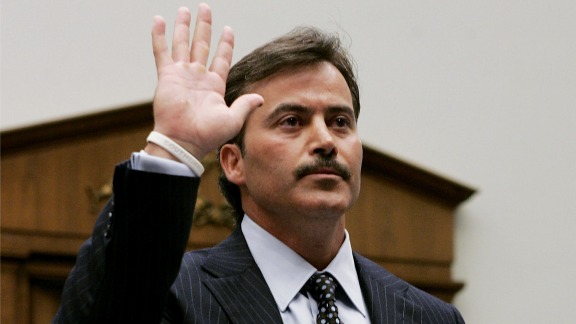 Palmeiro finished out the season and was never signed again.
He is more than likely never going to be voted into the National Baseball Hall of Fame.
This despite the fact that he's one of four players in MLB history to record over 3,000 hits and 500 home runs.
As for the other four players, they cashed in.
1. Juan Rincon had been a relief pitcher with the Minnesota Twins prior to his bust on May 2, 2005. He was peaking at $440,000 season with a 6-6 record and a 2.45 ERA.
The Twins ultimately held onto him until the trade deadline in 2008, but not after paying him $900,000 in 2006, $2 million in 2007 and $2.475 million in 2008 despite the fact that his ERA had doubled in those last two years. Rincon’s final year in the Majors came with the Detroit Tigers in 2009 at the cost of $750,000.
2. Franklin was making $2.6 million as a starter for the Mariners in 2005, but made the same amount the following season as a relief pitcher with the Philadelphia Phillies and a grand total of $12.05 million from 2007-2011 with the St. Louis Cardinals.
3. Morse is an easy player to forget about in the first wave mess because he really didn’t come into his own until he ended up on the Washington Nationals in 2009. He made roughly $393,000 in his final season with the Mariners in 2008, but he made $5.117 million with the Nats from 2009-2012 and $6.75 million between the Mariners and Baltimore Orioles in 2013. He is now a 31-year-old free agent outfielder with a .281 career average with a lot of power. He’ll probably clean up well over $6 million per year for the next five years at least.
4. Another then-nobody from 2005, Rafael Betancourt was in the midst of his third season in the Majors with the Cleveland Indians when he got popped right around the All-Star break in 2005. At the time he was a decent relief pitcher with a great strikeout per nine innings ration and an ERA under 3.00 and making $338,000.
After that, his stats stayed about the same, but his salary jumped up to $2.05 million in 2008, $3.35 million in 2009, was traded to the Colorado Rockies and has continued to pull in an average of $4 million per season now as the team’s closer who saved 31 games in 2012 and 16 in 2013 before injury. The 38-year-old is now a free agent and will probably find a one or two-year deal before the start of the 2014 season.

In all four of these cases there was never another violation of the drug policy; however, all four clearly went on to have incredibly lucrative careers.
In 2006 only three players were busted and only one of them returned to have a continued prosperous career, Guillermo Mota. Mota made $1.8 million with the New York Mets in 2006 and was re-signed to a two-year $5.5 million deal a full month after his violation.
He was then picked up by the Giants where he made just shy of $3 million from 2010-2012 until he was busted a second time and granted his walking papers at season’s end.
From 2007 to 2008 only six players got busted, one of which was pinched twice in a month, Neifi Perez who had violated the stimulant policy. The key part of the stimulant policy is that some medications which contained banned stimulants can be appealed and approved if the proper steps are taken.
While his career ended immediately afterward, the same cannot be said for Mike Cameron and Jose Guillen. Cameron went from making at least $7 million per year from 2005-2007, got busted for taking stimulants a second time and then was signed by the Milwaukee Brewers two months later to a two-year $16.25 million contract. He was then given a two-year $15.5 million contract by the Boston Red Sox after his Brewers deal expired.
Guillen on the other hand was the luckiest man on the planet as he received a three-year $36 million deal two days before he was suspended; however, his punishment was later rescinded after receiving amnesty for being named in the Mitchell Report. Both players had a decent 2008 campaign, but Guillen fell apart in his last two seasons even after getting traded to the Giants in 2010.
 Since 2009, a total of 19 players have received suspension with Mota getting his second included.
Manny Ramirez is probably the most notable of the group as he received his first and second suspensions within two years of one another. Oddly enough became one of the few people to receive a significant pay cut as a result of the suspensions:
from $18,695,006 in his final year of his contract with the Los Angeles Dodgers in 2010 after receiving his violation in 2009 down to $2.02 million with the Rays in 2011 where he received his second violation.
Even after both he had received a $500,000 minor league contract with incentives from the Oakland Athletics. Amongst the rest, Jhonny Peralta, Carlos Ruiz, Melky Cabrera, Bartolo Colon and Edinson Volquez are players who received higher-valued contracts after their suspensions, in most cases they will/did make more than prior to when they were busted.
Marlon Byrd took a substantial pay cut after his bust in 2012 as he was making $6.5 million between the Cubs and Red Sox down to $700,000 in 2013 between the Mets and Pirates; however, he was just recently signed to a two-year $16 million deal with the Phillies. It’s only a matter of time before Nelson Cruz signs a deal to play in 2014 and his current asking price stands at a four-year $75 million deal. He made $10 million with the Texas Rangers in 2013.
As it stands now, 17 of the 39 players listed had their careers end or did not receive a more lucrative contract following their suspension, 12 of them have received incredible extensions and contracts and the jury is still out in a few cases, namely Ryan Braun, Everth Cabrera, Antonio Bastardo, Freddy Galvis, Jesus Montero, Francisco Cervelli and Yasmani Grandal. It’s more than likely that Alex Rodriguez and possibly Miguel Tejada will be added to the list of those to never play again.
In each case, the odds have been stacked right down the middle that a player currently in the Majors with a lot of promise or a solid career already under their belt will more than likely stand to make more money after suspension. There are clearly more factors at work here; however, the end result is that in most cases there isn’t a General Manager in the game who wouldn’t consider a player based on their PED-related history.
One thing that needs to be taken into consideration with the most recent group of contract signees is that of the 5,391 urine and blood samples taken in 2013 only eight players were busted as a result of stimulants. Seven of those players, including Ruiz, came as a result of amphetamines found in Adderall.

Adderall is legal and approved by MLB only with the proper documentation and green light. The last suspension came as a result of methylhexaneamine, a nasal decongestant, taken by Toronto Blue Jays prospect Marcus Stroman. Therefore, any of the names listed in the Biogenesis scandal did not officially fail a drug test, they were only implicated, but all but Rodriguez willing accepted their suspension without admission of guilt.
This is a very important piece of the puzzle as Peralta’s four-year $52 million contract from the St. Louis Cardinals could be as a result of this fact, and the same could be said for Cruz’s eventual deal. One player who did take issue with it was Arizona Diamondbacks relief pitcher Brad Ziegler who said, “It pays to cheat...Thanks, owners, for encouraging PED use” on Twitter shortly after the Peralta deal was announced on November 24th. It’s only a matter of time before more players like Ziegler take their opinions on the matter to Twitter and eventually to the MLPBA meetings.

It’s an interesting debate, that’s for sure, but is it truly a problem that needs a resolution? Only three players have received multiple suspensions and only Mota made more money after the first bust.
Colon almost received a second suspension as a result of his name appearing on the Biogenesis list; however, that didn’t prove to be enough to punish him a second time especially since he hadn’t failed a drug test since his first on August 22, 2012.
The 12 players who have received massive contracts after suspension have yet to become repeat violators and in all cases prior to 2013 their stats had stayed the same or improved. Only in the case of Guillen and Cameron did they fall off.
While some will still hold hate in their heart for a lack of justice appearing to take place, the reality is that one of two things is actually taking place: MLB has done what they promised and cleaned up the game significantly and it’s right to reward those who learned their lesson and still perform to the best of their ability OR the science is evolving at a faster pace than MLB realized.