1: Jadeveon Clowney, DE, South Carolina
Last year, Clowney thrust himself into the national spotlight with his enamoring hit on Michigan’s Vincent Smith. The ball came out, Smith’s helmet went flying; it was the tackle heard ‘round the world. Although, Clowney’s legacy does not stop there.
Clowney is touted as one of the best defensive prospects of all-time, and rightfully so. He is an athletic phenomenon. The combination of speed, quickness, and power that he has is rare. It enables Clowney to win with either his speed or his strength, as opposed to most pass rushers who are stuck only being able to do one or the other effectively.
This season, opponents deliberately altered their gameplans to attempt to take Clowney out of every play. On passing plays, Clowney was often double-teamed, as well as having a running back shift to that side, just in case. When opponents ran the barely, it was rarely, if ever, in Clowney’s direction. The misconception that he got “worse” because he has not produced the same numbers as he did in years previous is nonsense. Clowney has not gotten worse. Teams simply do not allow him to do much of anything, taking away opportunities to make a statistical impact. Stats aside, Clowney is the best prospect in the 2014 NFL Draft.
2: CJ Mosley, LB, Alabama
Non-pass rushing linebackers, like Mosley, are seldom drafted highly, but that is due to positional value, not talent level. Talent-wise, Mosley is a top five player in this year’s class and is the most complete linebacker in the class.
Athletically, Mosley will not grab anyone's attention, but he is so fundamentally sound and intelligent that he does not need to be a stunning athlete. Pre-snap, it is often Mosley, along with Ha Ha Clinton-Dix (see player No.9), who is making adjustments and call-outs. He is able to break down the play before it ensues.
Unlike most, Mosley has a wonderful understanding on how to move around the field. He never wastes steps and flows well to fill a lane, then attacks it. Such fluidity and understanding of how to attack rushing lanes enables him to often stop running backs short of the line of scrimmage.
At the second level, Mosley is efficient in shedding blocks quickly and pouncing on opposing ball carriers. When the second level or line of scrimmage becomes clustered, Mosley does not have issues sifting through the trash, keeping an eye on the ball carrier, and taking him down.
In coverage, Mosley is not rivaled. When playing zone, Mosley is actively patrolling his area and works quickly down to the flat when necessary. He is able to quickly recognize routes and jump on them, taking away the man attempting to attack his zone. In man coverage, Mosley stays close to his man, not allowing any cushion. Few linebackers are such a beneficial factor in coverage.
3: Greg Robinson, OT, Auburn
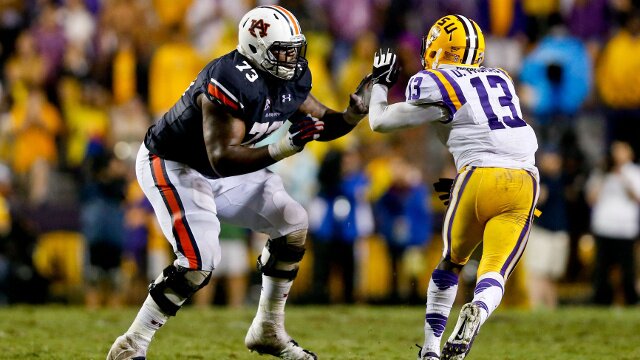 Until recently, Robinson was lost in the shuffle of Auburn’s dream season, yet he is their most talented player by far. The left tackle was a human bulldozer and allowed Tre Mason to flourish whenever Auburn ran to his side.
As a run blocker, Robinson was the best in the country. He squares up on his man, drills his overpowering fists into their chest, then proceeds to viciously drive him down the field, opening up gaping rushing lanes. With such power, one would assume Robinson is reckless, but he is not. Robinson understands his assignments and executes. When engaged, he is a mauler, but does so with balance and grace.
Due to Gus Malzahn’s heavy rushing system, Robinson rarely has to pass protect, but when he does, he handles it well. Robinson has a firm base and can keep defenders at bay with his initial violent punch. He is able to stonewall power rushers, as well as keep speed rushers out of the play and away from the quarterback.
4: Jarvis Landry, WR, LSU
More often than not, it is Mike Evans who gets praised as the best receiver in the SEC, but that is not the case. Jarvis Landry is a fluid, creative player that can attack defenses in a number of ways. He is more fit to play the slot, but if needed, he can line up outside and be effective.
Landry is the best route runner among this crop of receivers. His feet are quick, and because of that, he can make his breaks faster than defensive backs can react to, giving Landry separation. Landry is a creative route runner, as well. He is not a robot that forces himself to run routes the same way each time. He adjusts to the situation and gives off body and head fakes to get defensive backs out of position so that he can violate the open area of the field. When needing to get physical to gain separation, Landry can do so. Not to the extent of some of the larger receivers in the class, but to the extent that he can create space, if need be.
With the ball in his hands, Landry can be dangerous. He is not overly agile and will not make many defenders miss, but given space, he can separate from defenders and stretch the field for a long touchdown reception.
5: Dominique Easley, DE/DT, Florida
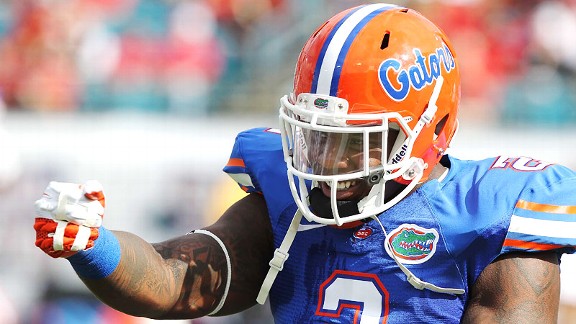 Despite a season ending ACL injury, Easley was one of the most disruptive players in college football. Also, he was the emotional leader and key to Florida’s defense. When he went down with injury, the Florida defense dropped off. He is technically a defensive tackle, but could function well as a five-tech at the next level, as well.
Easley is the most explosive player off of the line of scrimmage. As soon as the ball moves, Easley is attacking offensive lineman long before anyone else is. Such explosion allows him to win before a play has even developed, leading to countless tackles for loss and sacks.
Not only is he quick, but he is tenacious. Easley is a violent player that rips and slashes at opposing lineman to get himself off of them.
Easley is a well-rounded player. As expressed, he is a violent, effective pass rusher, but he is stout in run defense, as well. He controls his area of the line of scrimmage, assuming he did not already penetrate the line of scrimmage and make the play in the backfield. Once healthy, he will wreak havoc once again.
6: Jake Matthews, OT, Texas A&M
Recently, Texas A&M has been producing a handful of incredibly talented lineman and Matthews is no exception. Fundamentally, he is the best offensive tackle prospect in the class. Although, he is not as the athletic level of Robinson.
Matthews’ footwork is stellar. He is quick when moving out to the edge, and when rushers try to counter him, Matthews redirects and resets his feet better than any other lineman in the class. He does not allow rushers to easily vacate his frame, enabling him to keep rushers from going around him. When taking on power rushers, Matthews understands how to sink his hips and anchor, but sometimes, he is too slow to do so.
Where Matthews struggles is physicality. His punch is not powerful and does not force rushers to reset. If power rushers take on Matthews immediately, not allowing Matthews to sink his hips, Matthews can be quite easily knocked off of his base.
Nonetheless, Matthews is a master of the art, despite being an underwhelming athlete.
7: Kony Ealy, DE/OLB, Missouri
Missouri had a Cinderella season and Ealy was right in the middle of it. Ealy was the leader of Missouri’s superb defense and provide pressure from a multitude of positions. Ealy can thrive either from the five-tech or the LEO position (seven-tech, lined up wide).
Most pass rushers at the college level struggle to utilize their length, but Ealy is an outlier. Most rushers will immediately engage closely to lineman, but Ealy has a better understanding of the position. He extends his arms and creates space between himself and the opposing lineman, then makes his move using the space provided.
In space, Ealy is fluid and can break down to make a tackle without suffering any movement speed or time. He is a solid run defender both in such space and when engaged. In a class that is no too top heavy with pass rushers, Ealy could be taken in the first round due to the lack of other options.
8: Johnny Manziel, QB, Texas A&M
 As the entire nation knows at this point, Manziel is the most enamoring player in the country. His style of play is unlike anything else. Although, such style may get him and his small frame injured at the next level. Nonetheless, if he can be tamed, Manziel will be a solid quarterback for years to come.
Manziel’s arm is not strong, but it is not weak, per say. Like Peyton Manning, the ball appears to float a bit, but manages to still make its mark. At times, Manziel’s footwork can hurt his accuracy, but often it does not. He can miraculously function without a set base, although, it should be something he sets out to work on in the upcoming off-season.
Mentally, Manziel is better than given credit for. He certainly has the ability to make proper reads and he has shown that, but sometimes, he seems to have the feeling that he needs to make a big time throw in order to prove something. In reality, he does not. If he would settle down and simply perform, he would have no need to prove anything. He also has a superb understanding of how to anticipate receivers over the middle of the field, despite Texas A&M not attacking that part of the field too often.
Manziel is a risky prospect, but if he can be tamed, there will be few defenses that can stop him.
9: Ha Ha Clinton-Dix, S, Alabama
Although he is not the top ten talent that he is often perceived as, Clinton-Dix is arguably the top safety in the class. Although he may be more suited for strong safety, Clinton-Dix could play free safety at the next level, as well.
The only issue with Clinton-Dix playing free safety is that he appears late to plays. More often than not, when he meets a receiver, he is too late to make a play on the ball.
As a strong safety, Clinton-Dix can make a huge impact at the next level. He is a strong, willing tackler that can come in hot with momentum. Once he locks into the ball carrier, Clinton-Dix closes quickly and closes the gap before the ball carrier can get any more yards.
Contrary to common belief, Clinton-Dix will make his money near the line of scrimmage, not back in coverage. Nonetheless, he is in contention to be the top safety.
10: Travis Swanson, C, Arkansas
Much like Mosley (see No.2 player), Swanson will go later than his talent level due to how his position gets valued. Swanson has the talent to be a first rounder, but centers are often not taken that high, despite being the most crucial player for a successful offensive line. That is more of a flaw in the draft system than anything.
Swanson is a smooth player. He can flow in space and transition well from block to block. He understands how to use his length to his advantage and keep lineman away from his frame, disabling them from having the upper hand. When rushers attempt to bull rush, Swanson has a firm base that is not easily penetrable.
In space, and in pass protection, Swanson stays square to his man. When run blocking, this allows him to move his body and seal off defenders, opening up large rushing lanes for his running backs. When space become compacted, Swanson still functions well. He is strong and commanding enough to take control of crowded situations and make the most of it.
Five years from now, Swanson will be the best interior lineman in the class, not just from the SEC.